Supplementary oxygen canisters
The ClimbSupplementary oxygen canisters were not merely equipment carried toward the summit: their number, placement, and distribution governed the Mountain Madness team’s plan for climbing and returning from Everest. A supply calculated to cover a successful May 10 attempt offered little reserve for delays, and during the descent the oxygen cache did not match what some climbers expected to find. The canisters thus became a practical limit on the expedition’s choices and a recurring point of uncertainty in the account of the climb and rescue.
Inventory and planned use
At Camp IV, Mountain Madness had sixty-two canisters: nine heavier Zvesda canisters and fifty-three lighter Poisk canisters. That total represented 51 percent, by volume, of the oxygen purchased from Henry Todd. Most of the remainder had already been used, particularly by Pete Schoening and Ngawang Topche Sherpa; a smaller amount was kept at Base Camp for medical emergencies. The different types had separate purposes: the nine Zvesda canisters were reserved for sleeping before the summit attempt, while the Poisk supply was set aside for the climb itself.
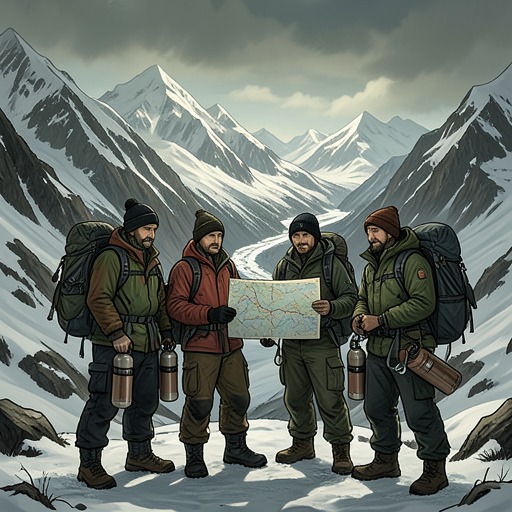
The expedition’s calculation left little room for a second attempt. Six climbing Sherpas were going up; five planned to use oxygen, while their climbing sirdar, Lopsang Jangbu Sherpa, climbed without it but carried a canister for emergencies. Each of the other five Sherpas carried two canisters for personal use and two more for clients and guides, for a total of twenty-one bottles carried by the Sherpas. The six clients, Scott Fischer, and Neal Beidleman carried two bottles each; Anatoli Boukreev carried one. Together, guides and clients carried seventeen bottles.
In all, the climbers took thirty-eight Poisk canisters up from Camp IV, leaving fifteen full ones there, as well as whatever remained of the Zvesda supply used the previous night. The remainder was not enough to support an overnight stay followed by another summit bid on May 11 if the first attempt ran into difficulty. For Charlotte Fox and Tim Madsen, the implication had already been made explicit: it was May 10 or no second try.
The plan and its assumptions
Fischer’s oxygen calculations drew in part on advice from Henry Todd, the supplier. At the recommended flow of two to two and a half liters per minute, Todd estimated that a Poisk canister would last six hours. Two, he advised, should provide twelve hours—enough, under the plan, to climb from Camp IV to the summit and descend to collect a third canister at the South Summit.
The timing was tight but appeared workable on paper. Leaving Camp IV at midnight, climbers could expect to reach the summit in ten or eleven hours if the weather held and no complications arose. At the recommended flow rate, they would have one or two hours of oxygen remaining there. The descent to the South Summit was expected to take between forty-five minutes and an hour; climbers would then collect the third canister cached by the Sherpas, whose additional six hours of oxygen were intended to carry them back to Camp IV. Every stage depended on the assumptions holding: steady progress, usable cached supplies, and no extended delays.
That reliance on staged distribution made the South Summit cache particularly important. Ten canisters were taken there for Fischer’s team: one for each of six clients and one each for Beidleman and Fischer to collect on descent. Two more were presumably carried as the backup Boukreev had requested, with Fischer’s agreement. Most climbers, already behind schedule, chose to collect their third bottle on the ascent instead. Beidleman’s third bottle had come earlier from Boukreev, who gave him the canister he had carried up from Camp IV.
Shortages and uncertainty on the route
The plan’s narrow margins became visible amid the congestion above the South Col. By 10:30 a.m., climbers from several expeditions were spread between the Balcony and just below the South Summit, delayed among one another on the route. At Todd’s recommended flow rate, those on their second canister had only one or two hours of oxygen left, while the third and final canisters had not yet reached the South Summit. The Sherpas carrying those additional supplies were themselves still strung out along the route. The intended handoff had therefore become vulnerable to the same delays that increased the need for oxygen.
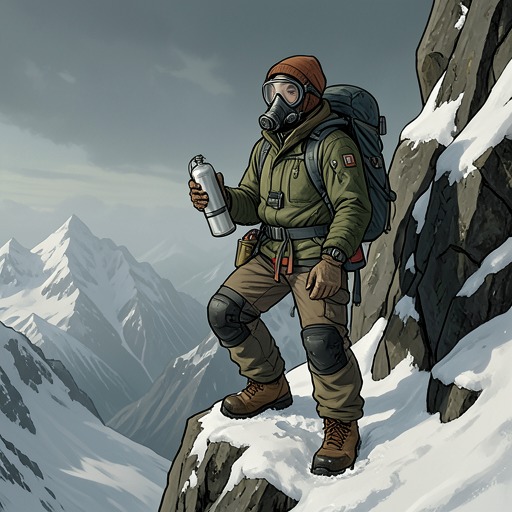
Beidleman and Martin Adams later compared their remaining supplies while waiting near the South Summit. Adams read five pounds on his gauge; Beidleman said he had the same amount, along with a full bottle from Boukreev. Adams proposed that they exchange what remained and continue, but the two did not move on then. The scene makes the gauge and the bottle consequential objects: the climbers could assess a small reserve, but that knowledge alone did not resolve whether to press ahead.
When Beidleman and the clients arrived at the South Summit, the cache did not appear to contain the supply they expected. Beidleman recalled finding one canister that was full or nearly full and a few partially full ones; he believed the full bottle went to Lene Gammelgaard. He took one of the partially full canisters, but the account does not establish whether others did. Charlotte Fox and Adams later said they took no additional oxygen. Adams recalled seeing Andy Harris sorting through a pile of perhaps twenty canisters in the alcove, but continued down without finding a bottle identified for him.
Descent, rescue, and narrative significance
As the descent grew more difficult, oxygen was redistributed according to immediate need rather than the original allocation. Beidleman turned the regulator on a new cylinder for Sandy Hill Pittman up to three or three and a half liters per minute, intending to revive her. The oxygen and the effects of dexamethasone appeared to help: within fifteen minutes Pittman felt able to move again. Gammelgaard also gave Pittman her own canister, describing the decision as an act of teamwork despite recognizing that both women were impaired. These episodes show the canister functioning both as an individually planned share and as a resource passed between climbers as conditions changed.
At Camp IV, the available supply was still a source of confusion. Boukreev had earlier received three canisters, yet when he sought oxygen for a renewed effort to reach the stranded clients, Pemba said none was available. Boukreev reasoned that some of the fifteen full Poisk canisters left at Camp IV must remain somewhere, but could not locate them. He eventually took the bottle Lopsang was using after insisting that he needed oxygen to go back up the mountain. The episode links a counted inventory to the harder problem of locating and accessing equipment when events no longer followed the plan.
Communications compounded that uncertainty. During the emergency, messages from Base Camp were relayed through several people and camps, and Ingrid Hunt considered the information reaching her incomplete or presented in an overly reassuring form. She had tried to arrange for oxygen to be sent up after learning of a reported collapse above the Hillary Step, but no one relayed that emergency to Boukreev when he reached Camp IV. The canisters mattered, then, not only as a finite supply but as equipment whose whereabouts and availability depended on coordination across the mountain.
The oxygen plan’s failure was not simply a matter of total quantity. The initial calculations depended on recommended flow rates and a predictable timetable; the climb instead involved delays, a stretched-out supply chain, uncertainty at the cache, and an emergency that required additional oxygen. The canisters make those dependencies tangible. Counted at Camp IV, divided among climbers, cached for a later handoff, and sought again during rescue efforts, they reveal how a carefully prepared summit plan could leave little reserve when the route and the weather disrupted its assumptions.